The VA CCN is changing: What home-based care providers need to know
Real-time VA RFP updates, practical guidance, and what we’re doing now to help keep your agency compliant and paid.
The VA has announced a major revamp of its Community Care contracts - a shift that will influence provider networks, compliance requirements (EVV/FWA), authorization flows, and reimbursement. This page is your VA RFP hub, with clear summaries and guidance geared toward home-based care providers.
Please Note: the VA Community Care RFP proposals are now due on May 8, 2026. The IDIQ award will commence in August 2026. Oral presentations are slated to be in October 2026. Regional TOPR awards will happen in January 2027.
Why the VA RFP matters
These are the operational, compliance, and financial implications that home-based care providers should be preparing for.

Network shake-ups
Expect changes in who manages networks, contracting standards, and performance metrics.
Higher bars for compliance
Stronger expectations around EVV, FWA (fraud, waste & abuse), data quality, and reporting.
Operational ripple effects
New portals, new edit sets, evolving prior authorization rules, and tighter payment integrity reviews.
Opportunity + risk
More access points for providers and home care agencies, and more ways to get delayed or denied if you’re not prepared.
What we know so far (in plain English)
We’ll keep this section updated as the VA releases clarifications and milestones about its latest RFP.


Large, multi-region contracts governing Community Care access and administration.

Dozens of technical and program documents detail expectations for eligibility, credentialing, data exchange, EVV/visit attestation, audits, and payment integrity.

Network adequacy, timely access, quality measures, compliance rigor, and vendor performance.

Contract changes at the prime level can cascade to new onboarding, re-credentialing, portal migrations, and revised billing/appeals processes for agencies.

Timeline at a glance
Key milestones and what providers should expect as Community Care changes roll out.

Questions/clarifications period and initial industry responses.
Evaluation/award window; early operational planning among awardees.
Transition/outreach to providers (network updates, credentialing waves, portal/EFT changes, new policy memos).
How this could change your day-to-day
These are the changes from the VA RFP that will likely affect the operations of a home care agency.

Contracting & eligibility
- New network managers may require (re)credentialing, roster updates, and fresh EFT/ERA setups.
- Member eligibility, benefit rules, and authorization pathways can shift, sometimes quickly.

Billing & payment
- Potentially new claim processes, attachments/documentation asks, and stricter EVV matching rules.
- Payment integrity reviews may increase; expect more pre-/post-pay validations.
- EVV-to-claim validation
may become a front-end payment requirement rather than a post-pay reconciliation issue.

Compliance & audits
- Stronger expectations for EVV accuracy, FWA training, and data quality.
- Tighter response SLAs for medical records, visit proof, and audit packets.
- Contractor-driven provider assignment may impact referral pathways and network visibility
VA to Provider Workflow Overview
Approved RFS Scenario
What to do now (provider checklist)
Immediate steps providers can take to stay compliant, credentialed, and ready as VA Community Care contracts change.
Lorem ipsum dolor sit amet consectetur ut consequat luctus a ornare auctor mauris necolmer doloe

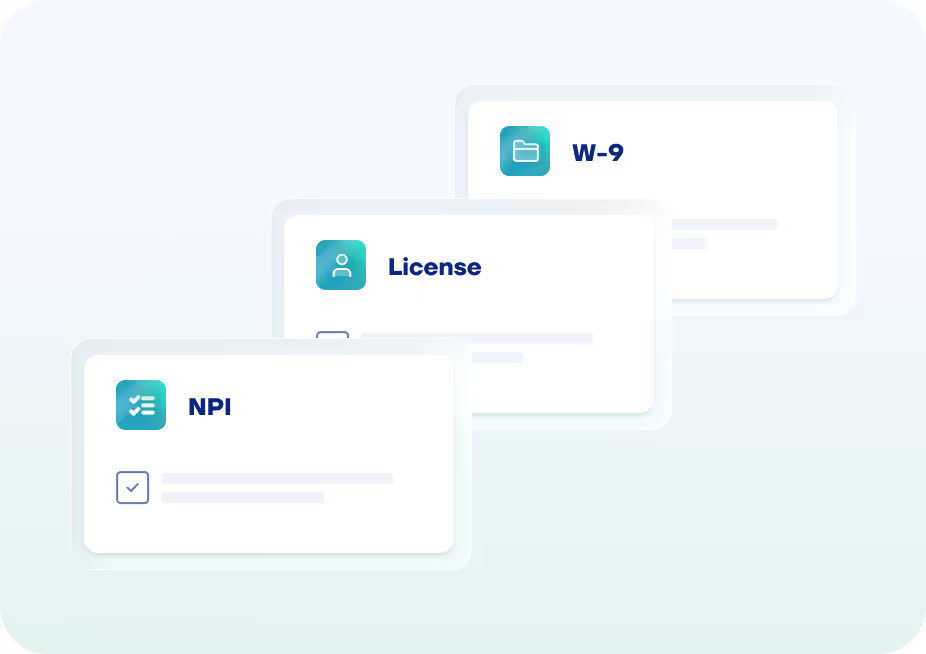
Credentialing hygiene:
Inventory your current VA Community Care contracts, portals, EFT/ERA, and points of contact.
EVV readiness:
Ensure your AMS is EVV capable and ready to integrate the new changes.

Data validation:
Confirm NPIs, pay-to, taxonomy, and clearinghouse settings are clean and consistent.

Documentation rigor:
Standardize notes, care plans, and visit attestations to be audit-ready.

What Paradigm is doing right now
Here's how Paradigm is preparing to help providers through this transition.

We monitor releases, amendments, and clarifications, then translate them into provider-ready guidance.
We offer (re)credentialing guidance, portal/EFT setup, roster loads, and training for your team.

We support pre-bill EVV-to-claim matching, contractor-specific submission workflows, and exception management to reduce payment risk.

We help with front-door hygiene, root-cause analysis, and work-to-closure processes (not “resubmit & hope”).

We offer first-pass yield and payer trend reporting that leaders can act on.

When contracts change upstream, Paradigm stabilizes revenue downstream, so you stay eligible, compliant, and paid.
Paradigm by the numbers
We're built to support high-volume providers while meeting complex payer and reimbursement standards.
Paradigm by the numbers
We're built to support high-volume providers while meeting complex payer and reimbursement standards.
$1B+
VA claims processed in the last 12 months

3,900+
Providers supported
All 50 States
Service nationwide with 8+ years of VA expertise
Frequently Asked Questions
Does the EVV have to match claims for payment?
Why this matters: EVV-to-claim mismatches may directly delay or prevent payment at the contractor level. This reinforces the need for pre-bill EVV validation and claim alignment.
Do EVV solutions vary by contractor?
Why this matters: EVV submission processes may differ by prime contractor. Providers operating across multiple regions may face multiple EVV workflows. Operational flexibility will be critical.
Who will assign providers when veterans do not choose?
Why this matters: This represents a meaningful shift. Network assignment authority will sit with the contractor, not directly with VA social workers. Contractor relationships and network positioning may play a larger role in referral flow moving forward.
Do you anticipate that provider reimbursement rates will change as a result of the new VA RFP? Will TPAs set provider rates, or will the VA continue to do so?
I’m a home care agency already approved and providing HHA and respite services to Veteran clients. What are some next steps or things to prepare for next?
Will we be able to sign clients up with Paradigm now and be able to get them the care they need with aide and attendance/home maker with minimal to no gaps in services when this goes into effect?
If you do not yet have Veteran clients, you can still sign up with Paradigm now, and we will provide credentialing and contracting services when the time comes.
When the contract is awarded, there will be a transition period. Paradigm will assist our customers in this process.

Compliance note
This page is for informational purposes only and summarizes public materials to support provider planning. Always review official VA communications and contract documents and consult your legal/compliance advisors.
Paradigm helps home-based care agencies stabilize revenue amid payer and policy change. When requirements shift, we keep your workflows compliant and your cash flow predictable.